La 18° Conferencia Internacional de DOCOMOMO confirma sus keynotes speakers para diciembre
La 18° Conferencia Internacional Docomomo 2024: “Futuros Modernos, Desarrollo Sostenible y Diversidad Cultural”será un evento académico relevante, que convocará a más de trescientos docentes, investigadores y estudiantes de diversas instituciones a nivel mundial, para promover el intercambio de conocimientos y estrategias para la conservación y adaptación sostenible del patrimonio moderno. Con ello, la instancia tendrá la misión de contribuir al desarrollo de entornos urbanos culturalmente diversos y sostenibles mediante la valorización y preservación del legado arquitectónico y urbano moderno.
Esta edición se realizará en Santiago de Chile desde el 4 al 14 de diciembre de 2024, específicamente en el Campus Lo Contador de la Pontificia Universidad Católica.
Esta oportunidad marca un hito importante porque es la primera conferencia internacional de Docomomo (Documentation and conservation of buildings, sites and neighborhoods of the Modern Movement), que se realizará al sur del Trópico de Capricornio, siendo Chile el escenario para exponer los principales desafíos del patrimonio moderno en el contexto de los cambios globales.
Se presentarán 40 sesiones conformadas por 240 presentaciones, marcadas por la diversidad temática en que se agruparon en los tópicos definidos para la instancia.
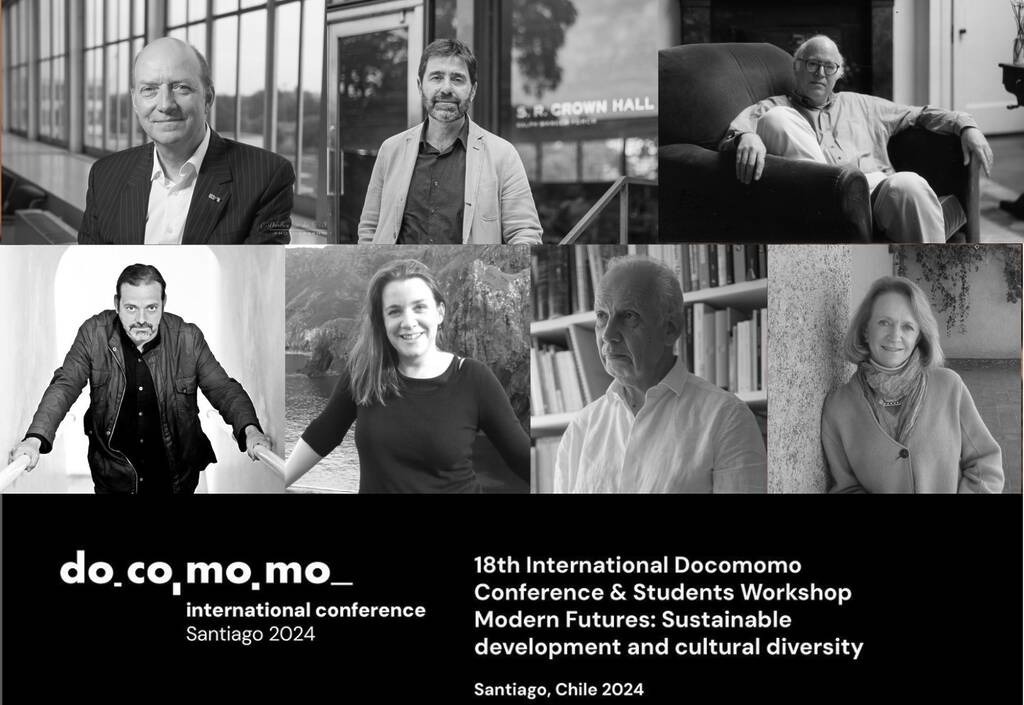
Los eventos que conforman la conferencia son variados y consideran: un Workshop del 4 al 10 de diciembre; conferencias con sus respectivas presentaciones del 11 al 13 de diciembre; y los tours del 9 al 14 de diciembre. Además, durante este mes se confirmaron a los key speakers: Louise Noelle Gras, Richard Sennett, Fernando Pérez Oyarzún, Jennifer Goff, Michelangelo Sabatino y Mauricio Rocha. Todos de diferentes nacionalidades y con amplias trayectorias en los campos de la conferencia.
Actualmente está abierta la convocatoria del concurso de fotografías, que busca movilizar a la comunidad interesada en el patrimonio moderno. Se pueden enviar hasta 3 fotografías ligadas a las áreas temáticas de la conferencia con plazo máximo el 4 de octubre. Las fotos seleccionadas serán expuestas durante el congreso.
También está abierta convocatoria del Momo EWI, que convoca posters de iniciativas educacionales, que busca dar visibilidad a cursos/proyectos, realizados por estudiantes de los diversos niveles educativos (pregrado, magister, doctorado) hasta el 15 de Noviembre
¿Quiénes son los keynotes del evento?
- Louise Noelle Gras
Researcher at the Instituto de Investigaciones Estéticas of the Universidad Nacional Autónoma de México. Involved in many aspects of architectural history and criticism, being a co-founder and director of the Comité International des Critiques d’Architecture (CICA). Active in the field of the protection of the 20th Century architectural heritage as member of DOCOMOMO and ICOMOS. Member of the Academia de Artes, 1991. Jean Tschumi Prize of the International Union of Architects, 2011. Author of various books on Mexican and Latin American 20th Century Architecture amongst them: Arquitectos contemporáneos de México, 1989; Luis Barragán. Búsqueda y creatividad, 1996; and Arquitectos Iberoamericanos Siglo XXI, 2006. Since 2020, in charge of the Central Campus of the National University, a World Heritage Site, UNESCO.
- Jennifer Goff
Dr. Jennifer Goff is a Curator with the National Museum of Ireland where is responsible for the Eileen Gray collection, Furniture, Music and previously Silver, Metalwork, and the Science collections. As a Fulbright Scholar (2016-2017) at Columbia University, New York and at the New York School of Interior Design, she lectured extensively on Irish design and architecture.
Goff has curated exhibitions both nationally and internationally notably Eileen Gray, National Museum of Ireland, 2002 and was involved in the Eileen Gray retrospective exhibitions, at IMMA, Dublin, 2013-14, the Pompidou Centre, Paris, 2013 and the Bard Center, New York, 2020. She has lectured worldwide and written extensively on design and architecture. Goff authored Eileen Gray – her work & her world, Irish Academic Press, Dublin, 2014, which was shortlisted for Irish Published Book of the Year 2015.
- Richard Sennett
Richard Sennett currently serves as Chair of the UN Habitat Urban Initiatives Group. He is Senior Fellow at the Center on Capitalism and Society at Columbia University and Visiting Professor of Urban
Studies at MIT.
Previously, he founded the New York Institute for the Humanities, taught at New York University and at the London School of Economics, and served as President of the American Council on Work.
Over the course of the last five decades, he has written about social life in cities, changes in labour, and social theory. His books include The Hidden Injuries of Class, The Fall of Public Man, The Corrosion of Character, The Culture of the New Capitalism, The Craftsman, and Building and Dwelling.
Among other awards, he has received the Hegel Prize, the Spinoza Prize, an honorary doctorate from Cambridge University, and the Centennial Medal from Harvard University.
Richard Sennett grew up in the Cabrini Green housing project in Chicago. He attended the Julliard School in New York, where he worked with Claus Adam, cellist of the Julliard Quartet. He then studied social relations at Harvard, working with David Riesman, and independently with Hannah Arendt.
- Mauricio Rocha
Mauricio Rocha Iturbide is Mexican, founder of the Taller de arquitectura he shares since 2012 in partnership with Gabriela Carrillo.
As an architect he has carried out both public and private works, alternating with the realization of ephemeral architectural interventions in art exhibitions, as well as museography and artworks.
He has been a professor at the Faculty of Architecture of the UNAM, the Universidad Anáhuac and the Universidad Iberoamericana, as well as at universities in the United States and Latin America.
He is a member of the Mexican Academy of Arts. He has received the Mies Crown Hall Americas Prize (MCHAP) 2023, for his project for the remodeling and expansion of the Anahuacalli Museum by Diego Rivera and Juan O’Gorman around 1940, in Mexico City.
- Fernando Pérez Oyarzún
Architect, Pontificia Universidad Catolica de Chile, 1977; Doctor Architect from the Higher Technical School of Architecture of Barcelona, UPC, 1981.
He has worked as an academic at the School of Architecture since 1974, currently holding the position of Full Professor. He served as Director of the School between 1987 and 1990, and Dean of the Faculty of Architecture and Fine Arts between 1990 and 2000. In parallel, he has worked professionally as an architect, with some of his projects being exhibited and published in Chile and abroad. He has worked as in consultant in projects related to monumental buildings and some of his interventions have taken place within significant preexisting constructions. He was Visiting Design Critic at Harvard University in 1990 and Simón Bolívar Professor at the University of Cambridge, in the year 2000. His research has focused on topics of theory and history of architectural design, publishing books, chapters and articles in magazines such as Casabella, Arquitectura Viva, Projeto, Block, Harvard Architecture Review, CA, and ARQ.
- Michaelangelo Sabatino
Michelangelo Sabatino is a publicly engaged educator, historian, curator, and preservationist whose research and writing focuses primarily on architecture and the built environment of the twentieth century. Sabatino trained in art, architectural and design history, and preservation at universities in Canada, Italy, and the United States of America. He earned a professional degree in Architecture at the Università IUAV di Venezia and a PhD in the Department of Fine Art, University of Toronto. He held a post-doctoral fellowship in the Department of History of Art + Architecture, Harvard University. Sabatino taught at Yale University and the University of Houston before his appointment to IIT’s College of Architecture. Here, in addition to having served as the Interim Dean (2017-19) he currently directs the PhD Program in Architecture and is the inaugural John Vinci Distinguished Research Fellow. Sabatino’s research has been supported by a range of funding agencies and institutions such as SSHRC, Canadian Centre for Architecture and the Graham Foundation.
7. Wessel de Jonge
Wessel de Jonge is an architect and a professor of Heritage & Design at TU Delft, the Netherlands. In 1988 he was the founding Secretary of DOCOMOMO International until 2002, and remained an active figure in the international network ever since. The portfolio of WDJArchitecten includes the conservation and adaptive reuse of the Amsterdam Orphanage (A. van Eyck, 1960), the Netherlands’ Pavilion in Venice (G. Rietveld, 1954), and the ‘Zonnestraal’ Sanatorium in Hilversum of 1928 (with Bierman Henket Architects). He has been the co-ordinating architect for the conversion of the Van Nelle Factory in Rotterdam (1928-31), and a partner in the re-design teams for the Cité Modèle in Brussels (1958) and the Olympic Stadium in Helsinki (1938). Awards include the Knoll / Modernism Prize 2010 and the EU ‘Europa Nostra’ Grand Prix 2008 for the Van Nelle Factory project, which was inscribed in the UNESCO World Heritage List in 2014.
Para más información sobre la conferencia se puede visitar la web https://docomomoconference2024.com/ y también revisar la cuenta oficial de Instagram: @docomomoconference2024
Información periodística:
Juan Andrés Inzunza


